Trump, Xi, Putin Issue Joint Peace Declaration
Trump, Xi and Putin released a joint peace declaration after their first-ever trilateral summit in Shenzhen, pledging nuclear risk reduction, U.N. reform and increased oil supply.
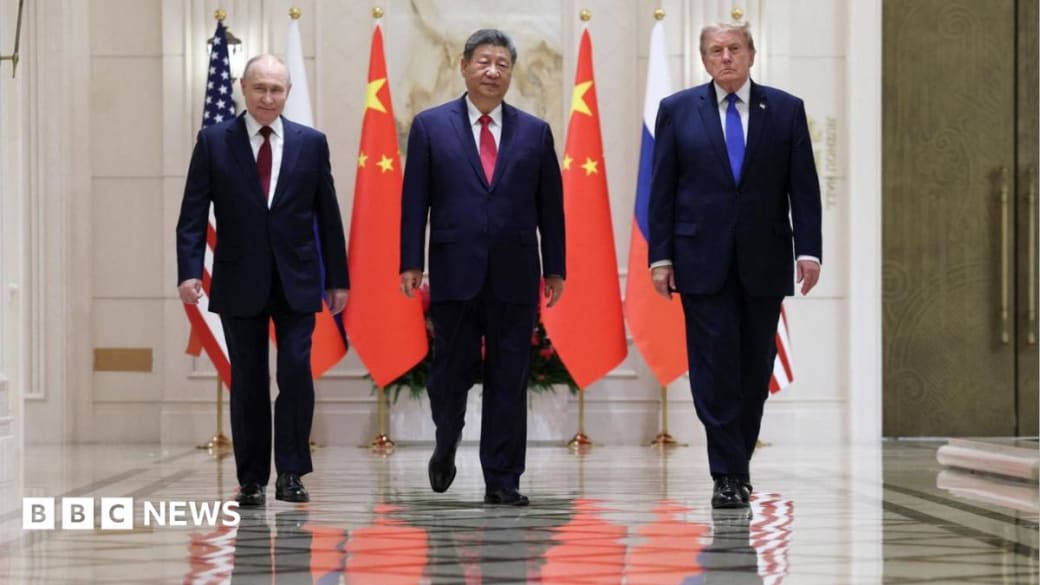
U.S. President Donald Trump, Chinese President Xi Jinping and Russian President Vladimir Putin issued a joint peace declaration yesterday after the first trilateral summit ever held among the three countries’ leaders. The 90-minute meeting took place in Shenzhen, in southeastern China, on the sidelines of the Asia-Pacific Economic Cooperation summit, the BBC reported.
The declaration states that “nuclear war cannot be won and must never be fought” and commits the three governments to increasing petroleum production and supply. The leaders also said they intend to reform the United Nations so it can respond more effectively to global challenges, according to the BBC. The document additionally addressed immunity for state officials, with the three sides agreeing that the International Criminal Court and similar bodies must not overreach their jurisdiction.
The declaration contained no new measures on nuclear risks beyond the stated pledge, and it did not mention the wars in Ukraine or Iran, Fast Company reported. Trump called the summit a success in a social media post while flying back to Washington aboard Air Force One, and said he would hold a White House news conference Friday to discuss the trip. In opening remarks before the closed-door session, Xi said cooperation among major powers was not optional but a requirement, while Putin pointed to a shared interest in ending the Ukraine war and said the talks would cover food and energy security.
The context
The United States, China and Russia had never previously held a three-way leaders’ summit, although the heads of state have met one-on-one at various points. While in China for the APEC gathering, Trump met separately with Putin ahead of the trilateral session, their first encounter since August 2025; the U.S. president greeted the Russian leader as his “friend,” the BBC reported. Trump also held a separate conversation with Xi and described their relationship as very special. Despite the cordial tone, the three leaders came to the table with different goals and motivations, according to BBC analysis, which characterized the summit as high on spectacle and short on substance. The meeting has dominated news coverage over the past week, but the declaration itself is the first concrete document to emerge from the process.
Why it matters
The three countries involved are nuclear superpowers, and a formal joint statement among them on reducing nuclear risks, even a thin one, changes how they engage on global security. The commitments on oil supply could affect energy markets if implemented, and the pledge on U.N. reform signals a shared willingness to revisit international institutions, including limits on the International Criminal Court’s reach. At the same time, the omission of the Ukraine and Iran wars leaves the most pressing active conflicts outside the agreement, raising questions about how far the cooperation extends.
What’s next
Trump said he will hold a news conference at the White House on Friday to discuss the trip. Key open questions include whether the declaration’s pledges on nuclear risk, oil production and U.N. reform will translate into concrete follow-up steps, and whether the three governments will address the Ukraine and Iran conflicts, which the document left out. No follow-up trilateral meeting has been announced in the material available.
Sources
Trump, Putin and Xi release ‘peace declaration’ after historic meeting
The first-ever trilateral meeting of the US, Chinese and Russian leaders ended with a joint ‘peace declaration’ including a nuclear-risk pledge.
Takeaways from the 1st ever China-US-Russia summit
AP breaks down what came out of the unprecedented Shenzhen sit-down between Trump, Xi and Putin, held alongside the APEC summit.
Trump, Xi, and Putin hold rare summit but deliver no breakthroughs on nuclear risks
The summit produced symbolic commitments on nuclear risks, UN reform and oil supply, but notably no mention of the Ukraine or Iran wars.
See a mistake? Report an error · Corrections policy
More from the November 20, 2026 Brief
Business
Anthropic IPO Fails to Stem Global AI Selloff
Global stocks fell sharply Friday as Anthropic’s record $1.5 trillion IPO failed to revive the AI…
Politics & World
White House Fires National Cyber Director Cairncross
The White House removed National Cyber Director Sean Cairncross and named Pentagon chief information…