Earth's Oceans Hit Hottest Temperature on Record
Global ocean surface temperatures reached 21.10 degrees Celsius on Saturday, the highest reading since records began in 1979, according to the European Union's Copernicus Climate Change Service.
The Morning Brief Desk · August 25, 2026 · Based on reporting by Scientific American
The average surface temperature of the world's oceans hit 21.10 degrees Celsius, or about 70 degrees Fahrenheit, on Saturday, August 22, the European Union's Copernicus Climate Change Service reported. It is the hottest reading since the agency began keeping records in 1979, narrowly passing the previous high of 21.09 degrees Celsius recorded on three separate days in March 2024.
The figure covers seas outside the polar regions and is built from measurements taken about 10 meters below the surface by buoys, ships and satellites, which are combined into a global estimate, according to the BBC. Scientists acknowledge the margin over the old record is small and that any global estimate carries uncertainty, but they say the timing stands out. Worldwide sea temperatures usually peak in March or April, at the end of the Southern Hemisphere summer, not in August.
"This record is another clear signal of an ocean under growing stress," said Samantha Burgess of the European Center for Medium-Range Weather Forecasts, which runs Copernicus. Burgess said El Nino is adding heat to a system already warmed by decades of human-driven climate change. Zachary Labe, a climate scientist at the research nonprofit Climate Central, told Scientific American the result was consistent with decades of research and said the warming will continue without cuts in fossil fuel burning.
The context
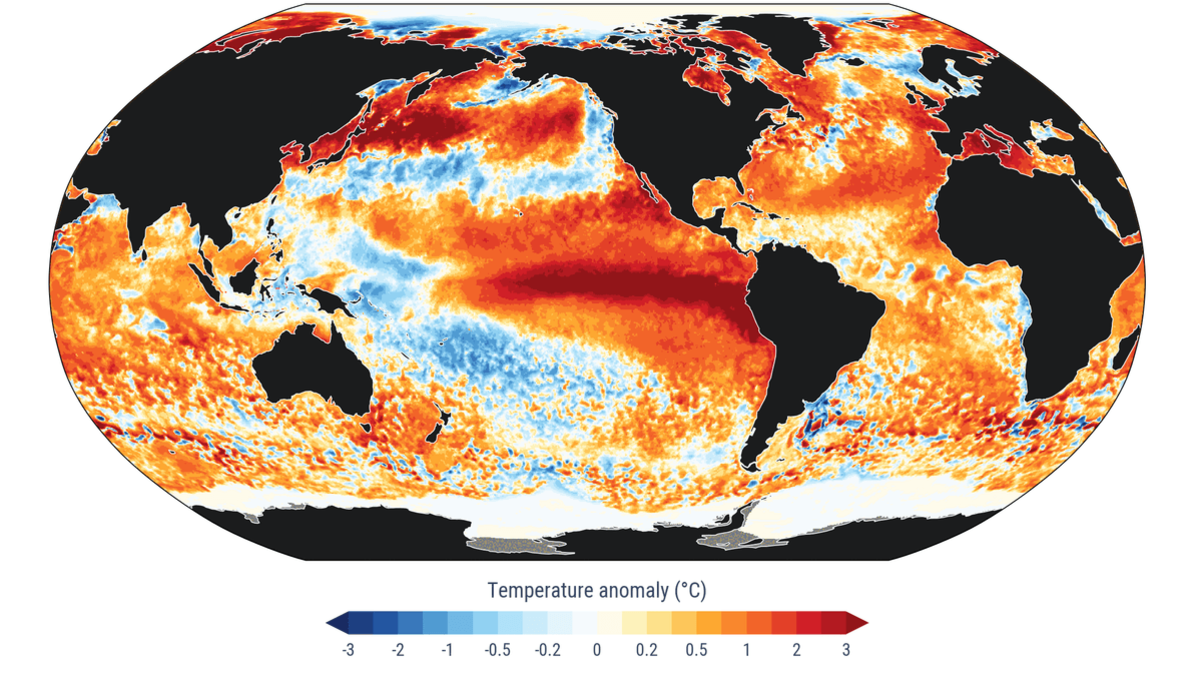
Two forces are pushing ocean temperatures upward at once. Long-term warming driven by human activity has raised the baseline over decades, and on top of that sits a strengthening El Nino, the periodic climate pattern that brings unusually warm water to the surface of the eastern and central tropical Pacific. Because El Nino warms such a large area, global average temperatures typically climb during these events.
What concerns researchers is that this El Nino is still well short of its expected peak. Forecasters expect it to keep strengthening until around Christmas, and scientists cited by the BBC warn it is on course to be the strongest in centuries. Jeremy Grist, a senior research fellow at the National Oceanography Centre in Southampton, said breaking records this early is a sign of how strong the event is becoming. The Southern Hemisphere holds more of the planet's ocean surface than the north, which is why global sea temperatures normally peak during its late summer rather than in August.
Why it matters
The record arrives just as the Atlantic enters the historically most active stretch of hurricane season, and warmer surface waters have implications for storm intensity. Beyond storms, hotter oceans can worsen sea-level rise, disrupt weather patterns and harm marine life, including coral reefs and fisheries. Labe said the effects can reach nearly every part of society, from the economy to coastal infrastructure and global security. For U.S. coastal communities, the combination of record ocean heat and peak hurricane season raises the stakes for the weeks ahead.
What’s next
El Nino is forecast to keep strengthening through roughly the end of the year, which could push ocean temperatures higher still. Labe said the new record is unlikely to stand for long and could fall again within months. Grist said that, all things being equal, the record might be broken again in March or April 2027, when global sea temperatures typically reach their annual peak. The Atlantic's most active hurricane weeks are the immediate test.
Sources
Scientific American — Earth's oceans just hit their hottest temperature ever recorded
The world's oceans hit 21.10 degrees Celsius on Saturday, breaking a record set in 2024, according to the European climate service Copernicus.
BBC — Oceans hit highest temperature on record
Global ocean surface temperatures have reached their highest level on record amid climate change and a super El Niño, with implications for fisheries, coral reefs, and storm intensity.
See a mistake? Report an error
 Science & Technology
Hurricane Isaias Strengthens to Category 2, Gulf Coast Evacuates
Phys.org
 Science & Technology
Francis Halzen Wins Physics Nobel for Cosmic Neutrinos
Scientific American
 Science & Technology
OpenAI Launches Always-On Dots Agents, Eyes $1.4T Valuation
TechCrunch
 Science & Technology
OpenAI Halts Training of Most Capable Models
AP News