Astronomers Detect First Atmosphere on Rocky Habitable-Zone Planet
Researchers report helium escaping from LHS 1140 b, marking the first atmosphere detected on a rocky, temperate exoplanet in its star's habitable zone, according to a study published in Science.
The Morning Brief Desk · July 20, 2026 · Based on reporting by Nature
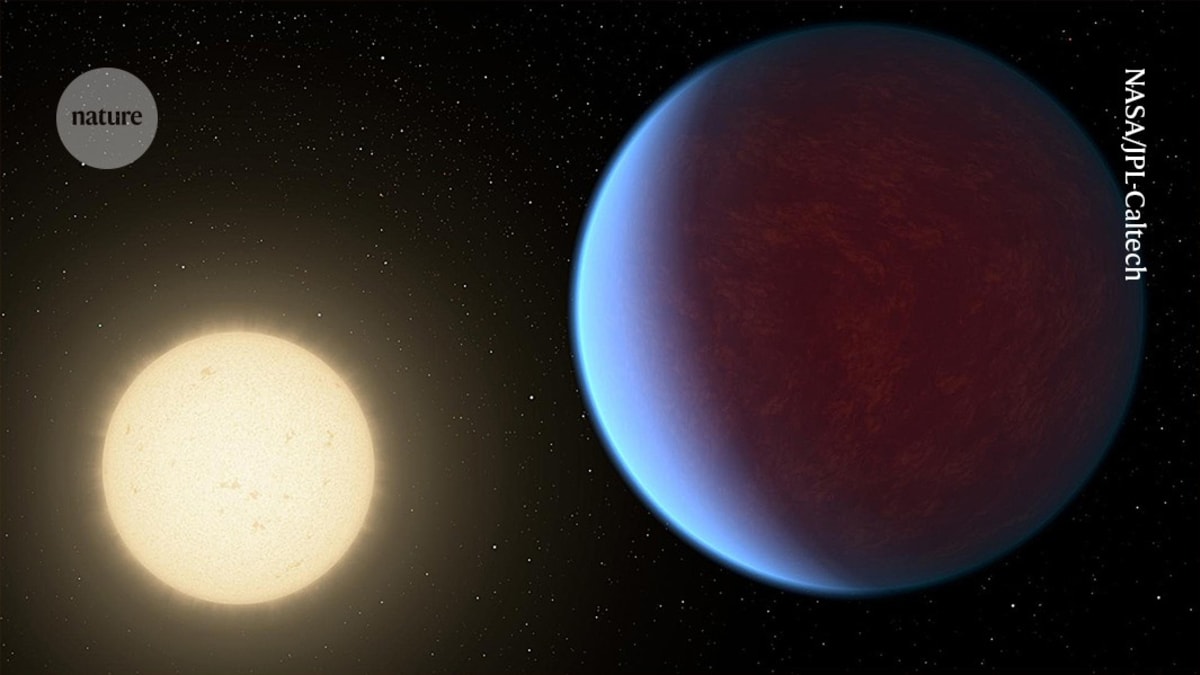
Astronomers have detected an atmosphere on a rocky, temperate planet orbiting inside its star's habitable zone for the first time, according to a study published Thursday in the journal Science. The team observed helium escaping from LHS 1140 b, a super-Earth about 49 light-years from our solar system, indicating the planet has a helium-rich upper atmosphere.
The habitable zone is the region around a star where temperatures could allow liquid water to exist on a planet's surface. Collin Cherubim, a postdoctoral fellow at Harvard University and the study's lead author, told Scientific American that LHS 1140 b now meets the three main criteria for habitability: a rocky composition, temperatures compatible with liquid water, and evidence of an atmosphere. "This is the only planet that we know has all three of those things," he said, adding that it is relatively nearby and orbits a comparatively quiet star not prone to violent eruptions.
The finding comes with caveats. The study cannot confirm whether water is actually present on the planet, and it does not establish the composition of the lower atmosphere. The researchers said the results will need to be replicated in future observations. Sara Seager, an astrophysicist at the Massachusetts Institute of Technology, described the findings to Nature as a missing piece of the puzzle on whether rocky exoplanets can hold atmospheres.
The context
LHS 1140 b was discovered in 2017 orbiting a red-dwarf star roughly 15 parsecs from Earth, and it was considered a promising candidate in the search for potentially habitable worlds from the start, Scientific American reported. Detecting atmospheres on rocky exoplanets has been a longstanding goal in the field, but it is technically difficult. Most observations to date have turned up airless worlds or atmospheres too faint to distinguish, according to Nature. Signs of atmospheres had been reported on a few other rocky exoplanets, but those detections were rare and not definitive. Cherubim's team targeted LHS 1140 b because their computational models predicted the planet would show escaping helium, which would signal the presence of an atmosphere. Astronomers have long theorized that atmospheres on rocky planets could regulate climate, shield surfaces from radiation and allow liquid water to persist.
Why it matters
For Earth-like life to exist, scientists generally look for three ingredients: a rocky surface, an atmosphere and liquid water. Until now, no rocky, temperate planet in a habitable zone had a confirmed atmosphere, so this detection removes a key uncertainty about whether such worlds can retain the air they would need to be hospitable. The result also supports earlier hints that small rocky planets can hold atmospheres at all, a question that shapes how astronomers prioritize targets in a galaxy that likely contains millions or billions of such planets.
What’s next
The researchers said the results need replication through future observations before firmer conclusions can be drawn. Key open questions include whether liquid water is present on LHS 1140 b and what the planet's inner atmosphere is made of, neither of which the current study resolves. Whether the planet could actually support life remains undetermined, and follow-up observations of this and similar exoplanets will be the next step.
Sources
Nature — Found: a rocky exoplanet with an atmosphere -- could it host life?
Astronomers spotted helium escaping from LHS 1140b, an exoplanet orbiting in its star's habitable zone -- the first atmosphere detected on a rocky, temperate world.
Wired — The Search for Another Earth-Like Planet Just Took a Big Step Forward
The discovery of a rocky exoplanet with an atmosphere inside its star's habitable zone marks a major milestone in the hunt for potentially habitable worlds.
Scientific American — A super-Earth exoplanet's leaking helium could be evidence of a complex atmosphere
LHS 1140 b lies in its star's habitable zone, and its leaking helium suggests a complex atmosphere -- making it a prime candidate as a possible host for life.
See a mistake? Report an error
 Science & Technology
PHP Vulnerabilities Force Major Websites Offline Worldwide
Wired
 Science & Technology
Musk Pledges SpaceX Share for Every US Child
Axios
 Science & Technology
FTC Subpoenas OpenAI and Anthropic Over Safety Failures
Ars Technica
 Science & Technology
Eight States Sue OpenAI Over Child Safety
The Verge