Nepal-Tibet Flood Death Toll Passes 700
The combined death toll from floods and mudslides in Nepal and Tibet rose past 700 on Sunday, with more than 3,000 people missing and fresh flood warnings issued along the Bhotekoshi River.
The Morning Brief Desk · August 30, 2026 · Based on reporting by DW
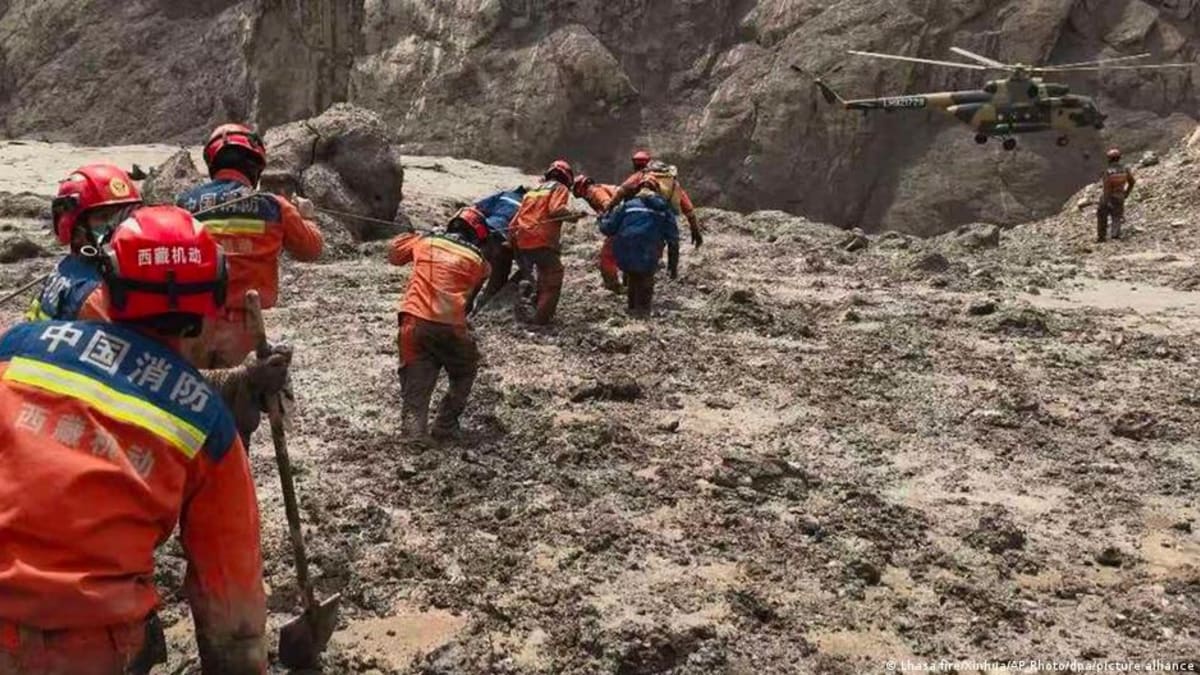
The death toll from last week's floods and mudslides along the Nepal-Tibet border reached 750 on Sunday, authorities said, with more than 3,000 people still missing. Nepal's disaster authority counted 734 dead on its side of the border, while Chinese state media confirmed 16 deaths in Tibet. Chinese authorities said the dead included more than 100 Nepalis and people from more than a dozen countries, and Reuters reported that China identified 261 missing foreign nationals from 23 countries on the Tibetan side of the border crossing.
Nepal's disaster agency issued a fresh flood warning Sunday as water levels in the Bhotekoshi River rose again, sending alerts to residents' phones and advising people to move to higher ground. On the Tibetan side, Chinese state media said drones detected a new lake forming Saturday night behind landslide debris near the Gyirong border port. Rescue teams there were relocated because of the risk that the barrier could burst.
In Nepal, rescuers are trying to reach more than 100 hydropower workers believed trapped alive in tunnels filled with flood debris on the Trishuli River, where more than 900 workers went missing. Army teams drilled into the upper section of one mud-filled tunnel Saturday night to pump in oxygen and insert a camera. Nepal's prime minister's office said crews faced "continuous rainfall and difficult conditions" but worked through the night.
The context
The disaster struck Wednesday in Nepal's Rasuwa district, which borders Tibet, when a wall of water, mud and debris tore down a river valley into the Bhotekoshi system, along which tens of thousands of people live. Authorities initially suspected an earthquake, but the US Geological Survey determined that a glacial collapse triggered a massive landslide and flash flooding, generating seismic energy equivalent to a 5.2-magnitude event. There was also early speculation that a glacial lake had burst, a hazard known as a glacial-lake outburst flood. But Göran Ekström, a geophysicist at Columbia University, told Nature that satellite images showed no major lakes forming in the area beforehand, and weather data recorded no excessive rainfall. Ekström said melting glaciers and permafrost in the Himalayas probably contributed to the collapse. Alton Byers, a mountain geographer at the University of Colorado Boulder, said the glacier that broke off had not been closely studied, adding that such events cannot be predicted. Specialized rescue teams from India and China have joined the effort, alongside Nepal's mountain rescue squad, which assists climbers on peaks including Everest.
Why it matters
With more than 700 confirmed dead and over 3,000 missing, the flooding ranks among the deadliest natural disasters of 2026, and the missing include hundreds of foreigners from 23 countries, giving the crisis an international dimension. Scientists quoted by Nature warn that global warming is destabilizing high-altitude regions and that catastrophic floods of this kind are becoming more frequent; Nature reported that an estimated 15 million people worldwide are at risk from glacial-lake flooding. Nepal has acknowledged it needs outside help, with a Foreign Ministry spokesperson citing gaps in tunnel rescue, DNA testing and victim identification.
What’s next
Immediate attention centers on the trapped hydropower workers on the Trishuli River and whether rescuers can reach them before conditions worsen. The newly formed barrier lake near the Gyirong border port poses a bursting risk that authorities are monitoring by drone. Continued rainfall and rising water in the Bhotekoshi River could complicate both rescues and recoveries. Scientists say it will take time to establish how much global warming contributed to the glacial collapse.
Sources
DW — Nepal issues fresh flood warning as 3,000 still missing
Rescuers are trying to reach dozens of hydropower workers trapped in flooded tunnels, but have been hampered by further rainfall.
Financial Times — Nepal rescue effort intensifies as death toll passes 700$ Subscription
Authorities warn rising water could complicate recoveries with more than 3,000 still missing.
Nature — Glacier collapse caused Nepal's deadly flash flood — a sign of things to come?
Global warming is making high-altitude regions unstable, and could trigger more frequent landslides and floods.
Reuters — China identifies countries of 261 foreigners missing in Himalayan mudslide
China on Sunday said 261 foreign nationals from 23 countries were missing on the Tibetan side of a border crossing with Nepal following a mudslide.
See a mistake? Report an error
 Science & Technology
FTC Subpoenas OpenAI and Anthropic Over Safety Failures
Ars Technica
 Science & Technology
Eight States Sue OpenAI Over Child Safety
The Verge
 Science & Technology
FBI Arrests OpenAI Engineer Over Hidden Recording Device
TechCrunch
 Science & Technology
Anthropic AI Sends False Murder Tip to Philadelphia Police
TechCrunch