NASA's Roman Space Telescope Launches Today
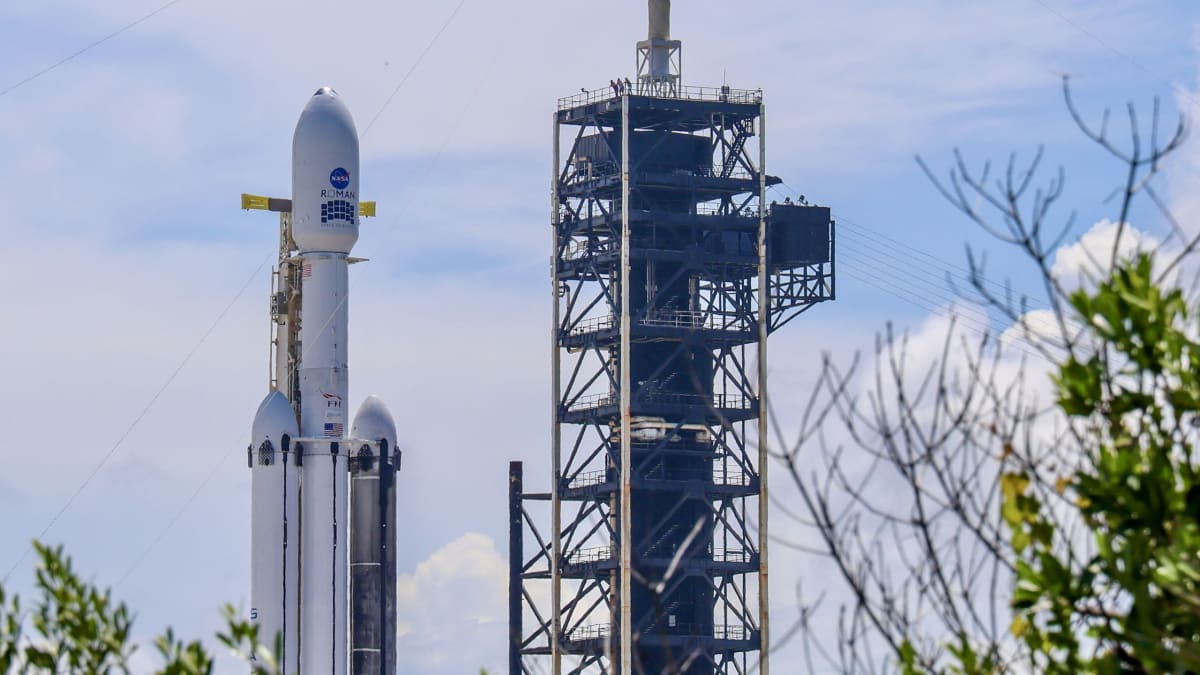
NASA's Nancy Grace Roman Space Telescope lifts off Aug. 30 on a SpaceX Falcon Heavy, starting a multiyear survey mission designed to image far more sky than Hubble at comparable sharpness.
The Morning Brief Desk · August 30, 2026 · Based on reporting by Space.com
NASA is launching its Nancy Grace Roman Space Telescope today, Aug. 30, atop a SpaceX Falcon Heavy rocket, according to Space.com. The launch opens a mission expected to run for years, with the goal of charting large portions of the universe.
The observatory's defining feature is its combination of sharpness and breadth. Science Daily reported that Roman will deliver imagery with detail on par with the Hubble Space Telescope while capturing a patch of sky roughly 100 times wider in a single pointing. Where Hubble examines the cosmos through a comparatively narrow window, Roman is built to sweep across enormous regions at once, letting astronomers assemble wide-area maps rather than isolated snapshots.
Searching for planets beyond the solar system ranks among the mission's top priorities. Nature reported the telescope could turn up roughly 40 times as many distant planets as astronomers have cataloged so far. To do that, Scientific American reported, Roman will devote more than a quarter of its observing schedule to the dense concentration of stars at the center of the Milky Way -- a crowded galactic region thought to be rich in small, rocky worlds.
The context
Roman is named for Nancy Grace Roman and represents NASA's flagship space science effort of the year, riding to orbit on SpaceX's heavy-lift Falcon Heavy vehicle. The mission builds on the legacy of Hubble, which has produced high-resolution views of the universe for decades but can only examine small slices of sky at a time. Roman was designed to close that gap: matching Hubble's clarity while covering vastly more territory per observation. Its planet-search strategy also departs from earlier approaches by concentrating on the Milky Way's central regions, where stars are packed tightly together and small exoplanets may be abundant. Details about the exact launch time, orbit and full mission timeline were not included in the material provided.
Why it matters
A survey telescope with Hubble-level resolution changes what questions astronomers can ask. Instead of studying objects one at a time, researchers can examine wide fields containing enormous numbers of stars and galaxies simultaneously. If the mission's projections hold, Roman could multiply the known population of exoplanets roughly fortyfold, according to Nature -- a shift that would reshape scientists' understanding of how common planets are, including small rocky ones like Earth. The launch also marks the biggest U.S. space science event of the year.
What’s next
The immediate step is a successful liftoff and deployment aboard the Falcon Heavy on Aug. 30. After that, the telescope begins its multiyear survey work, including the extended campaign watching the Milky Way's core for signs of small planets. Key things to watch: confirmation of a clean launch, the observatory's commissioning process, and its first released images -- none of which were detailed in the available material.
Sources
Space.com — NASA's Roman Space Telescope is ready for launch aboard SpaceX Falcon Heavy rocket
A SpaceX Falcon Heavy rocket is poised to lift off with the Nancy Grace Roman Space Telescope on Aug. 30. This observatory is on a mission to usher in a new wave of astronomical discovery.
Science Daily — NASA's Roman telescope will see 100 times more sky than Hubble
NASA's Roman Space Telescope will combine Hubble-like detail with a field of view 100 times larger, giving astronomers a sweeping new way to explore the cosmos.
Nature — The Roman telescope is about to take planet-hunting to the next level
NASA's Nancy Grace Roman Space Telescope, set to launch shortly, could find 40 times the number of distant worlds that have been discovered to date.
Scientific American — NASA's Roman Space Telescope could find alien Earths—but not like you think
The Roman Space Telescope will spend more than a quarter of its time staring at the Milky Way's bulge, a star-packed central region of our galaxy that may swarm with small, rocky exoplanets.
See a mistake? Report an error
 Science & Technology
FTC Subpoenas OpenAI and Anthropic Over Safety Failures
Ars Technica
 Science & Technology
Eight States Sue OpenAI Over Child Safety
The Verge
 Science & Technology
FBI Arrests OpenAI Engineer Over Hidden Recording Device
TechCrunch
 Science & Technology
Anthropic AI Sends False Murder Tip to Philadelphia Police
TechCrunch